
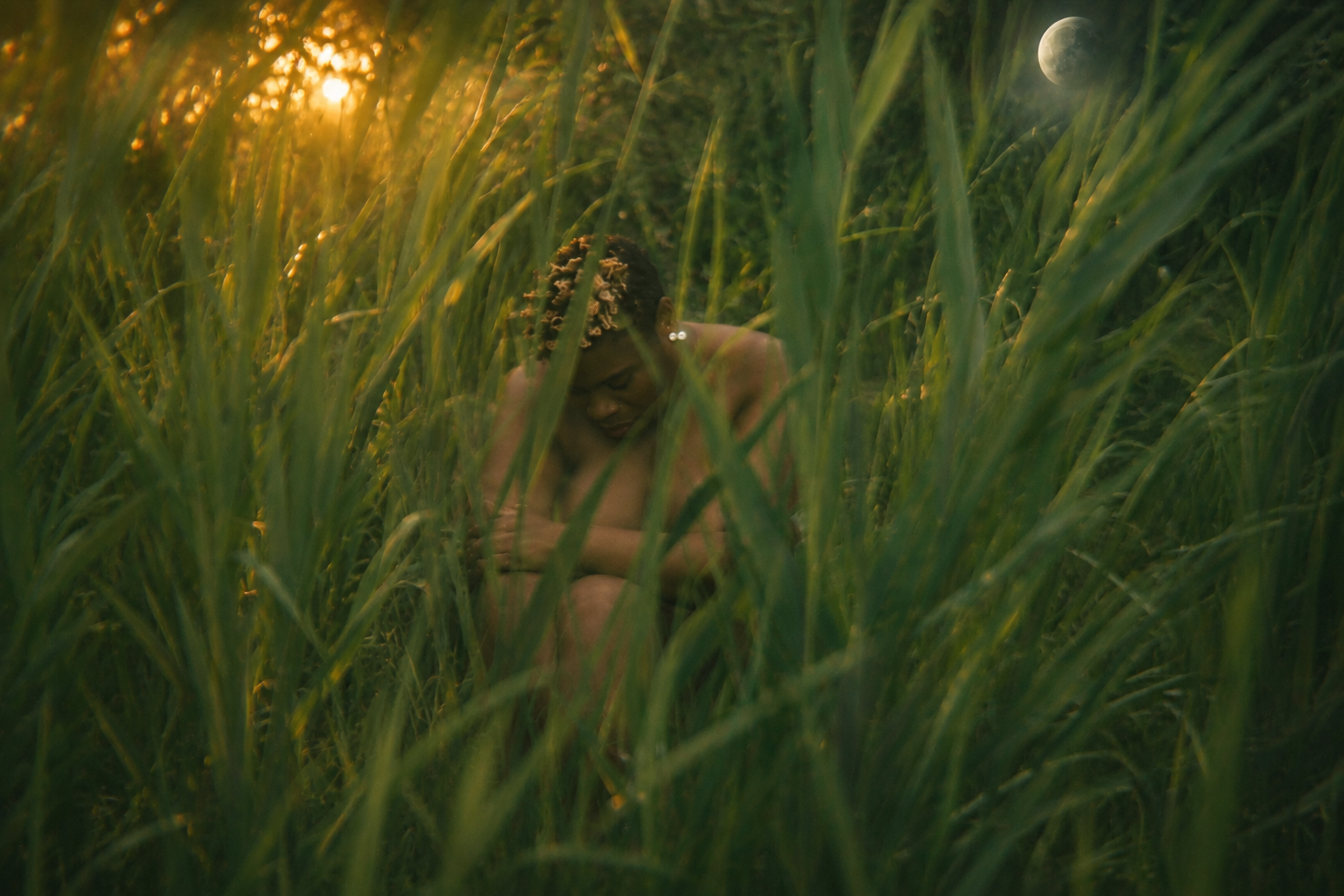
TIKA by Sarah May Taylor
A personal essay from a developing collection of autobiographical writings on art, love, inheritance, and the freedom to become.
- TIKA
My grandmother used to tell me that life was like a game of poker.
She would say that most people believed they had three choices: they could win, they could lose, or they could draw.
And then she would remind me of something that has stayed with me for the better part of my life.
You don't even have to play the game. You can walk away.
I don't think I understood how radical that lesson was when I first heard it.
Because we are born into worlds with rules that precede us. Rules about who we should become, how we should behave, what success should look like, and what we must accomplish to be considered worthy of love, respect, or belonging.
And for many of us, particularly Black children, those rules are introduced long before we have the language to question them.
We learn how to participate before we learn that participation might be a choice.
We learn how to succeed before we learn that success might have more than one definition.
And sometimes, we learn how to make other people proud before we learn how to recognize ourselves.
But before my grandmother ever taught me that I could walk away from the table, she and my grandfather had already demonstrated what it meant to imagine another life.
My grandfather was a carpenter. My grandmother was a librarian.
They were both from Jamaica, and in their respective parishes, they were anomalies. Two people who imagined lives beyond what was expected or familiar to them.
They left Jamaica together, in love, carrying the hope of building something different in Canada.
And I think there's something important about that.
Before they ever taught me to imagine otherwise, they had already done it themselves.
They had chosen each other. They had chosen possibility. They had chosen to leave behind the familiar and begin again.
And perhaps because they had given themselves that freedom, they understood the importance of extending it to others.
They approached the people they encountered as opportunities for connection rather than people to be judged against predetermined expectations. They made room for difference because they had already given themselves permission to be different.
When they purchased their first home in Oakville, Ontario, my grandmother wanted a library.
So my grandfather built her one.
I think about that gesture often.
A carpenter building a library for the woman he loved.
Not telling her what she should read.
Not deciding how she should spend her time.
Not asking her to justify why she needed a room devoted to books.
Simply making space for something that mattered to her.
And then he built another extension to their home.
A beautiful family room.
And in that family room were two magnificent skylights.
I was fourteen years old when I moved out of my mother's home and into my grandparents' house.
My mother was a single Black woman doing what she could with the circumstances she had. But our relationship had become difficult, and we were fighting. Eventually, I went to live with my grandparents in the suburbs.
They wanted to raise me.
They wanted me to have a second chance.
I stayed with them for approximately seven years, before they were both diagnosed with Alzheimer's disease.
And for those seven years, I had the privilege of lying beneath those skylights, looking through the glass and into the open sky.
Sometimes I would simply rest.
Sometimes I would think.
Sometimes I would dream.
And sometimes, nothing needed to happen at all.
There was no assignment attached to those moments. No expectation that my imagination would become something productive. No demand that I turn what I saw into a plan, an accomplishment, or a future anyone else could understand.
I could simply lie there and look upward.
I didn't have to earn the sky.
When I think about that period now, I don't think only about the change in households.
I think about the change in possibility.
My grandparents were not offering me a perfect world.
They were offering me something perhaps more valuable: freedom and autonomy within an imperfect one.
They understood, through the lives they had built together, that love did not have to mean control.
Love could mean making room.
Love could mean recognizing another person's desires without experiencing them as a threat to your own.
Love could mean building something for someone without determining what they must do inside it.
My grandparents offered me something that extended beyond shelter, stability, or supervision. They introduced me to a different way of seeing the world.
They showed me that the life I knew was not necessarily the only life available to me.
That the expectations I had inherited were not necessarily the expectations I had to fulfill.
That the rules I had been taught to follow were not necessarily the only rules by which a person could live.
And perhaps most importantly, they gave me permission to imagine otherwise.
That permission changed my life.
Not because they handed me a predetermined future, or because they knew exactly who I would become.
But because they helped me recognize that I had choices.
And I wonder how many children grow up without ever being told that.
How many young people spend their lives trying to win games they never agreed to play?
How many confuse being loved with being obedient?
How many believe that becoming themselves will inevitably mean losing the people they love?
And how many adults, without necessarily intending to, teach children that their success is the repayment owed for the sacrifices made on their behalf?
I have spent much of my artistic life thinking about these questions, although I didn't always have the language to articulate them.
As an artist, musician, and composer, my work has taken many forms. I've created music, produced performances, built cultural communities, nurtured emerging artists, and developed spaces where people could encounter possibilities beyond those immediately available to them.
Through The Known Unknown and BAREGYAL, I witnessed what could happen when young people were given room to express themselves without having to fit a predetermined mould.
But I also began to recognize something more complicated.
Nurturing another person can be a profound act of generosity.
It can also become an act of expectation.
Sometimes we give because we genuinely want someone to experience something beautiful.
Other times, we give because we hope their eventual success will affirm our sacrifices, our judgment, our generosity, or our importance in their lives.
And the distinction matters.
Can we nurture someone without needing their life to become evidence that our nurturing was successful?
I think about this question in relation to parents, educators, mentors, and anyone entrusted with another person's development.
A child may begin imagining a future that looks nothing like the one their parents imagined.
They may reject a profession, a tradition, a belief, or an expectation that has been passed down through generations.
They may discover an identity or an ambition that unsettles the people closest to them.
And sometimes, rather than being celebrated, their independence is experienced as rejection.
Their growth becomes an affront.
Their difference becomes disrespect.
Their freedom becomes something other people feel they are losing.
But what if another person's possibility does not diminish our own?
What if a child's freedom is not evidence of a parent's failure?
What if nurturing means creating room for someone to become a person we could never have imagined, rather than shaping them into the person we hoped they would be?
And what if they never become anything extraordinary at all?
Would they still deserve the same love?
I believe they would.
I believe they do.
But my understanding of love has not been shaped only by the people who made room for me.
It has also been shaped by the people whose lives and choices I struggled to understand.
For much of my childhood, my father was absent from my life.
My parents were very young when I was conceived. My father was already in another relationship, and I later learned that he had initially wanted my mother to terminate the pregnancy.
My mother did not want him involved in raising me. Throughout my childhood, I understood him largely through what I was told about him: that he came from the wrong side of the tracks, that he wasn't a good person, and that there were reasons he wasn't part of my life.
At nineteen, something unexpected happened.
My mother called to tell me she had discovered an old child support payment in the basement, one she had forgotten about, and asked whether I wanted it.
I said yes.
On the document was an address.
I used a reverse directory lookup, found a telephone number, and called it.
And just like that, after nineteen years, I reconnected with my father.
He told me he had been looking for me for years.
Within a week or two, we arranged to meet. I met my father and the sisters I had grown up apart from. His side of the family welcomed me warmly, and for the first time, I began to experience a relationship I had previously known only through absence.
I didn't understand why my mother had wanted so much distance between us.
The person I was getting to know seemed different from the person I had been told about.
And for the next twenty years, I built a relationship with him.
I came to know him, or at least I believed I did.
I loved him.
And in many ways, that relationship felt like the closest I had ever come to experiencing the kind of love I had longed for.
Then, three months before his death, my father told me something he had kept from me for almost two decades.
He disclosed that he had caused serious harm to my mother when they were young.
It was information that fundamentally changed my understanding of their relationship, his absence from my childhood, and the person I believed I had come to know.
I remember what I said to him.
I cannot forgive you for something that didn't happen to me. And I cannot forgive you on behalf of my mother.
But I also told him that I appreciated his willingness to tell me the truth.
Not because telling the truth erased what he had done.
Not because confession automatically amounted to repair.
But because, after so many years, I was finally being given information that belonged to the history of my own life.
I could begin to understand things I had never understood before.
I could begin to reconsider the complicated relationship I had with my mother.
I could begin to examine how violence, secrecy, and inherited pain had shaped the relationships around me, including my own experiences of sexual harm.
And I could begin thinking about what I might want to do differently if I ever became a parent.
I did not have to absolve my father to receive the truth.
And I did not have to assume responsibility for my mother's healing to recognize the significance of what she had experienced.
Three months later, my father died.
I was left with a grief I did not know how to name.
I was mourning a man I had loved for twenty years, while also reckoning with the knowledge that he had withheld something fundamental about himself.
I was grieving the father I knew.
And I was grieving the father I now understood I had never fully known.
For a long time, I struggled with the contradiction.
How could someone who had caused such serious harm also have made me feel so deeply loved?
How could the relationship that had offered me comfort also have been built around a silence that changed everything?
And what was I supposed to do with the love I had already given?
Eventually, I began to understand that acknowledging the love I experienced did not require me to excuse the harm.
And acknowledging the harm did not require me to pretend that every moment of connection had been meaningless.
The love I experienced was real to me. So was the harm he had concealed.
Neither truth erased the other.
I also began to reconsider my relationship with my mother.
For years, I had experienced our relationship as tumultuous and painful. There were things about her anger and her distance that I could not understand.
My father's disclosure gave me another way to consider that history.
It did not excuse the ways I had been hurt. And it did not mean I could know precisely what she felt or why.
But it allowed me to recognize that my parents had lives, experiences, and wounds that existed before I did.
Their histories were not mine to resolve.
Their choices were not mine to justify.
And their capacity or inability to love me in the ways I needed was not a measure of my worth.
I could see them as people.
Imperfect people.
People capable of love and harm, tenderness and cruelty, truth and concealment.
And I could finally begin to release the responsibility I had carried for making sense of all of it.
I did not need to choose a single story about my father to move forward.
I did not need to deny my mother's suffering to acknowledge my own.
And I did not need either of them to become different people before I could begin living differently myself.
There was freedom in that realization.
Not the freedom of pretending the past had not happened.
But the freedom of recognizing that the past did not have to dictate every relationship I would have with myself or with others.
My grandparents had taught me that I could walk away from the game.
My relationship with my father confronted me with another truth: that I could love someone without taking responsibility for making them innocent.
And somewhere within those experiences, I began to understand that love without ownership also requires us to recognize the limits of what we can forgive, repair, or carry on another person's behalf.
This question has become particularly important to me as I think about the language of Black excellence.
I understand why excellence has occupied such a significant place in Black cultural life. In societies that have historically denied Black people recognition, opportunity, safety, and dignity, achievement can become a powerful form of resistance.
But I also wonder what happens when excellence becomes an expectation rather than a possibility.
When resilience becomes compulsory.
When being exceptional becomes the price of being seen.
What happens to the Black child who is ordinary?
The child who is tired?
The child who is grieving?
The child who is disabled, uncertain, quiet, or uninterested in competing?
The child who simply wants to exist?
Are they any less deserving of care?
And how do we prepare Black children to navigate institutions that may demand exceptional performance without teaching them that those demands determine their worth?
I believe we must hold both realities.
We cannot pretend that structural inequities disappear because we encourage children to dream.
Black young people still require resources, skills, opportunities, protection, and the ability to navigate systems that may not have been designed with their flourishing in mind.
But we must also resist teaching them that their humanity is something to be earned through exceptional achievement.
We can teach Black children how to navigate the world without teaching them that they must earn the right to exist within it.
I have also come to understand that nurturing requires a different relationship with time.
This past year has been one of the quietest periods of my musical life.
I haven't been creating or releasing music at the pace I once did.
Instead, I've been resting.
Sleeping.
Swimming.
Paying attention to my body.
Making room for rehabilitation, reflection, and the experiences I hadn't yet fully processed.
In a culture that rewards constant production, this kind of quiet can be difficult to explain.
Artists are often expected to be making something.
An album.
A performance.
A new project.
A body of work.
And when nothing visible is emerging, the assumption can be that nothing meaningful is happening.
But my experience has taught me otherwise.
During this period of rest, something unexpected began to take shape.
Not an album.
Not a single.
Not even something I had necessarily intended to create.
Holding Two Truths emerged.
A body of thought that required me to examine my childhood, my relationships, my understanding of care, and the expectations I had inherited about who I was supposed to become.
And I began to think about creation differently.
What if an artist carrying an idea is, in a metaphorical sense, pregnant with possibility?
We understand that gestation requires care.
That nourishment matters.
That rest matters.
That not every stage of development is visible from the outside.
Why, then, do we so often treat creative stillness as failure?
Why do we expect the creator to produce continuously without considering the conditions that make creation possible?
And why do we imagine that rest is only worthwhile when something eventually emerges from it?
Because that, too, is a trap.
If rest must produce a breakthrough, an album, or a revelation to be considered valuable, then we have simply turned rest into another form of labour.
I want to imagine something different.
A world in which a person can rest without having to explain what their rest will accomplish.
A world in which solitude is not automatically interpreted as disengagement.
A world in which a child can daydream without being asked to turn that dream into a measurable achievement.
A world in which people can exist without constantly demonstrating that they are becoming more useful, more productive, more successful, or more extraordinary.
And when I think about that freedom, I find myself returning to the family room my grandfather built.
To the two skylights.
To the child who could lie beneath them without having to explain what she was doing.
Perhaps those moments taught me something about creativity long before I knew I would become an artist.
Perhaps they taught me that imagination does not always need an audience.
That stillness is not emptiness.
That being given room to dream is itself a form of care.
And that the freedom to become begins with the freedom to be.
Which brings me back to leadership.
What are we actually teaching when we teach someone to lead?
Are we teaching them how to become more confident, influential, visible, and successful?
Or are we teaching them how to recognize possibility in themselves and others?
How to exercise agency without controlling another person's choices?
How to nurture without ownership?
How to question the rules of a system rather than simply mastering them?
And how to recognize that sometimes the most meaningful exercise of freedom is deciding not to participate?
I have begun to understand leadership as the practice of expanding possibility through care, critical awareness, and self-determination, without requiring another person's life to validate our influence.
But I don't believe every child must become a leader.
I don't believe every parent must undergo a profound transformation.
And I don't believe every educator must become responsible for healing the emotional histories of the families they encounter.
What interests me is the possibility of three interconnected freedoms.
For the child: Freedom to Exist and Imagine Otherwise.
The freedom to be worthy before achieving anything. To dream beyond inherited expectations. To rest, question, refuse, explore, and discover possibilities without being required to fulfill someone else's ambitions.
For the parent: Freedom to See Possibility Without Feeling Diminished.
The freedom to recognize that a child's independence does not invalidate a parent's life. That another person's opportunities are not evidence of our own inadequacy. That love need not depend on whether someone becomes who we expected them to be.
For the educator: Freedom to Learn While Nurturing.
The freedom to remain curious. To question inherited ideas about authority, intelligence, achievement, and success. To recognize that nurturing doesn't require having every answer, controlling every outcome, or carrying responsibility for everyone else's transformation.
These freedoms do not require everyone to grow together.
They do not erase differences in power or responsibility.
Children are not responsible for managing adult disappointment, healing inherited wounds, or making other people comfortable with their autonomy.
And adults remain responsible for providing care, protection, and meaningful opportunities.
But perhaps these freedoms invite us to reconsider what care can make possible.
When I think about my grandparents now, I think about how much of my life has been shaped by the alternative vision they offered me.
They could not have known every direction my life would take.
They could not have predicted every song, performance, artistic community, or idea I would eventually create.
And I don't believe the value of their nurturing should be measured by any of those accomplishments.
Their care mattered before I became an artist.
Before I created anything.
Before I knew what I wanted my life to look like.
It mattered because I was a child who deserved to be loved.
And perhaps that's the truth I've been trying to articulate all along.
We can love someone without owning their future.
We can nurture someone without demanding a return.
We can imagine otherwise without surrendering our desire to belong.
My grandmother taught me that I could walk away from the table.
My grandfather built a room where I could look beyond it.
And somewhere between those two gifts, I began to understand that freedom is not simply the ability to choose a different life.
It is also the experience of being loved before we know what life we will choose.
To exist. To imagine otherwise. And to be loved.